
Back in May, the Driver and Vehicle Standards Agency (DVSA) introduced new rules designed to stop third-party booking services, bots and resellers from hoovering up practical driving test slots.
From 12 May, only learner drivers themselves were allowed to book and manage their own tests, while unofficial services were banned from scanning the booking system for available appointments.
Sensible measures
With the DVSA’s forward-looking booking-availability measure still sitting at around the 21-week mark nationally, anything that helps learners get their test is surely a good thing – black-market resellers would be pushed out of the system, with only candidates themselves able to make and manage their bookings.
As part of the crackdown, the DVSA also tightened enforcement. Its system monitors the booking service for activity that “does not look like normal personal use” and can suspend online access where it detects it.
Sucessful outcomes
Come June, the DVSA announced that it had imposed 4,034 online booking suspensions and cancelled 450 tests booked using payment cards linked to large numbers of different learners – all thanks to the new crackdown.
So far, so good, right?
Alas, according to frustrated learners and instructors venting online and to the Driving Instructors Association (DIA), there may have been unintended consequences – with genuine learners apparently being identified as suspicious users and locked out of the online system for 12 months.
What’s claimed to be going wrong?
Because of the extensive waiting times and patchy availability, learners commonly sit online:
- Mashing the refresh button on the booking page over and over again
- Searching through different test centres quickly
- Trying to snare an impromptu cancellation the second it appears
The claim being made to the DIA by irate learners is that the system may be misidentifying this kind of frantic – but entirely human – behaviour as automated or suspicious activity and suspending their online access.
The important caveat is that nobody outside the DVSA currently knows exactly what behaviour triggers the system. And that lack of clarity is part of the DIA’s complaint.
“In one case reported to the association, a trainer said his pupil was distraught after being told that her online access would be suspended for 12 months. When she telephoned the contact centre, he said, staff appeared unable to tell her how the problem could be resolved.”
— Driving Instructors Association
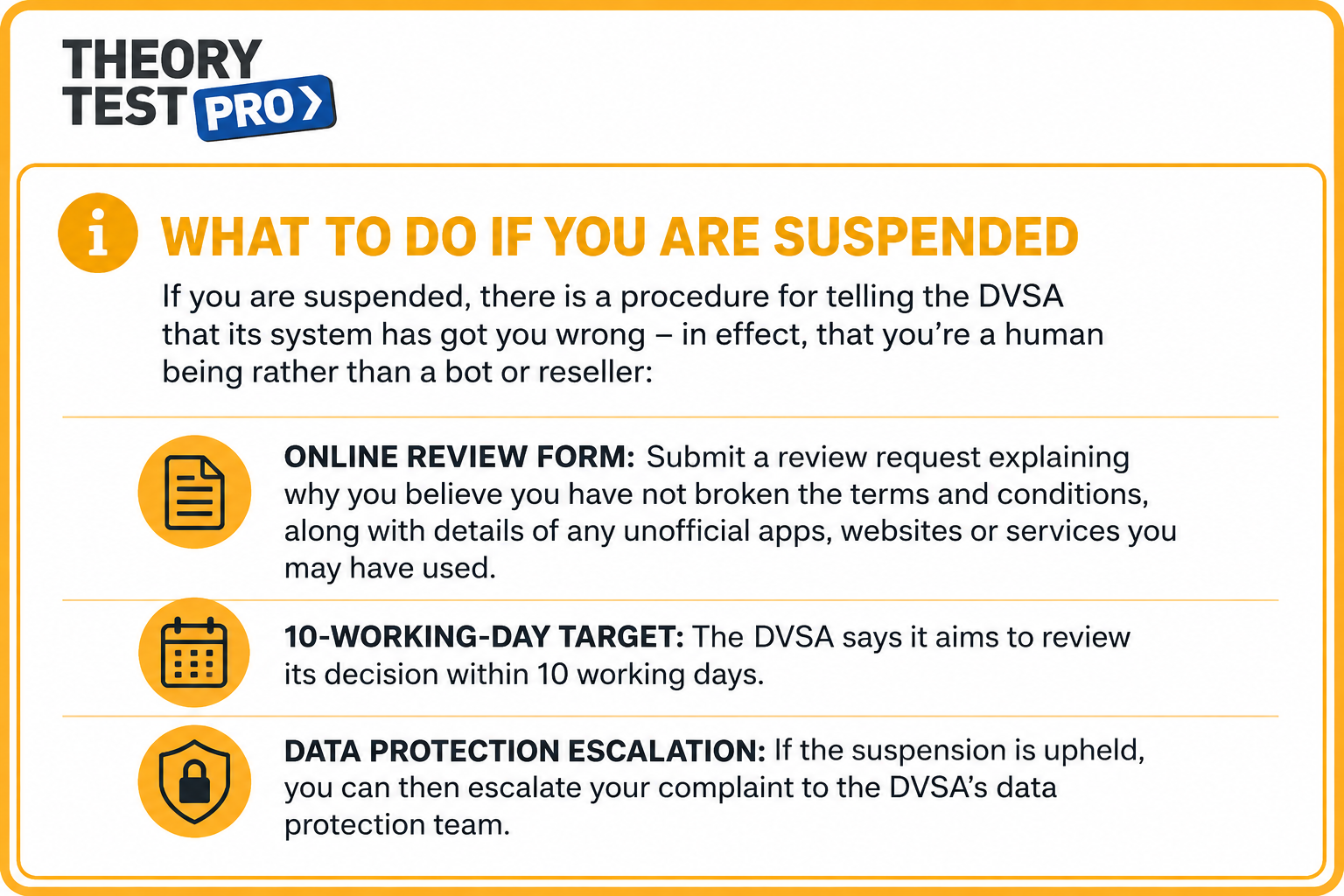
What to do
First, remember that you are only being suspended from the online practical-test booking system – not from trying to secure a test altogether.
You can still book, change or cancel a practical test by calling the DVSA. And if you already have a test booked, it will still go ahead as planned. The suspension also does not stop you booking a theory test online.
That said, when suitable appointments can appear and disappear in moments, losing access to the online system clearly puts you at a disadvantage.
More clarity needed?
While the procedure sounds reasonable in theory, the DIA points out that “the guidance does not explain what volume or pattern of activity crosses the line between an anxious learner repeatedly searching for an appointment and automated or commercial misuse.”
While we expect some ‘teething’ problems with any new or revised approach, such suspensions simply add further frustration for learners already pulling their hair out over getting a test.
The sooner any genuine users caught in the net can be identified and unbanned – and the rules around what constitutes suspicious behaviour made clearer – the better. We’ll keep you posted.
Know Your Code

Double your chances of theory test success with Theory Test Pro – sign up for free here!
Main image and boxout layout by ChatGPT